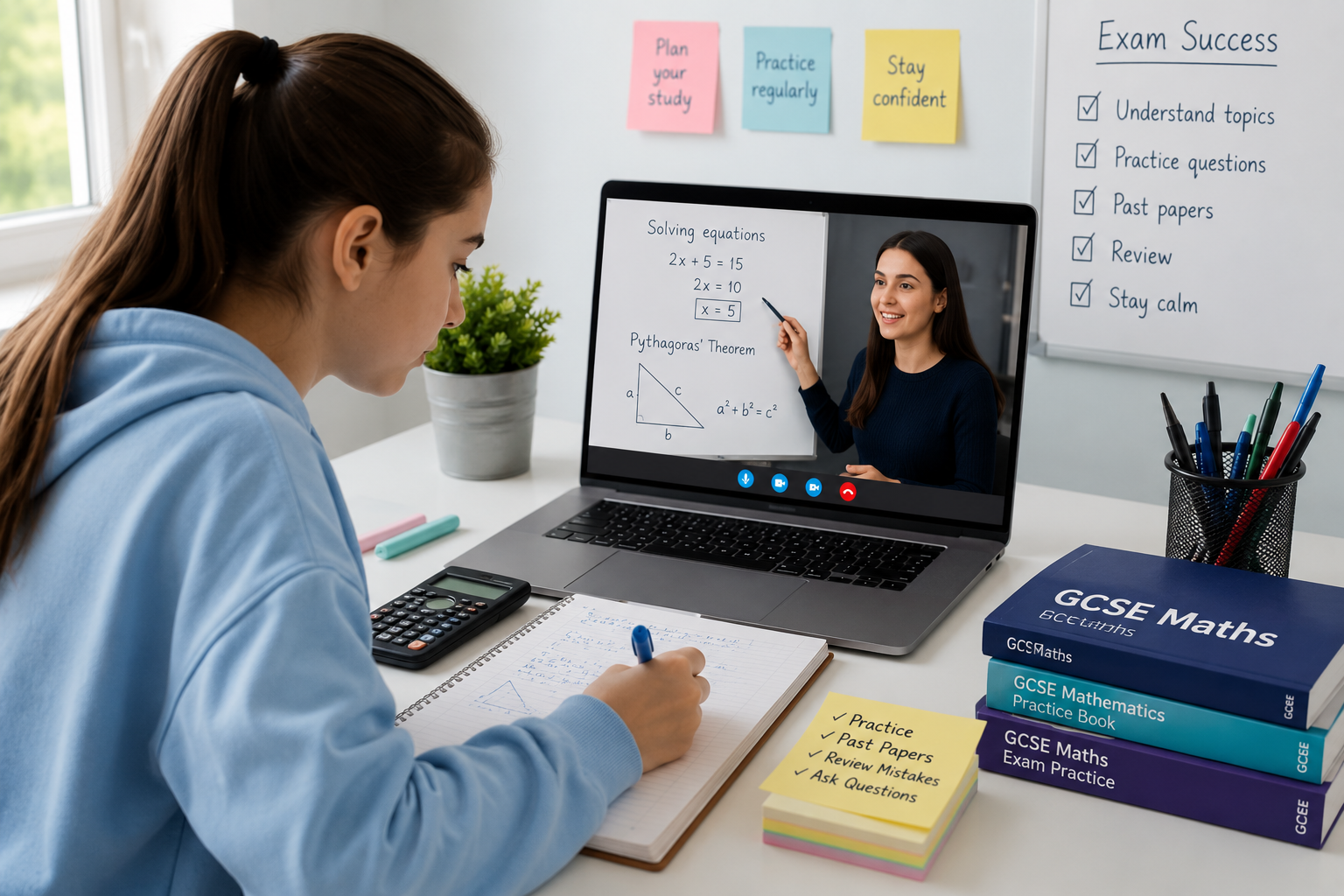

GCSE Maths revision can feel difficult when a student is unsure which topics to prioritise, keeps making the same mistakes, or struggles to apply methods to exam questions. Working with a tutor can provide a clearer structure for revision and give students regular opportunities to practise areas that need attention.
A useful gcses maths tutor plan should go beyond explaining formulas. It should identify gaps in understanding, practise the relevant skills, review mistakes and gradually introduce more exam-style questions.
Start by Identifying the Topics That Need Work
Before creating a revision schedule, it helps to establish which areas of GCSE Maths need the most attention.
A student may be comfortable with basic calculations but struggle with algebra, geometry or probability. Another student may understand individual topics but lose marks because they misread questions or cannot decide which method to use.
A tutor can review schoolwork, previous tests and practice questions to identify recurring problems.
Common GCSE Maths areas include:
- Number
- Algebra
- Ratio, proportion and rates of change
- Geometry and measures
- Probability
- Statistics
The exact topics and level of difficulty should be matched to the student’s GCSE specification and exam board.
Build Revision Around Weak Areas
Revision time is limited, so spending equal time on every topic may not be the most effective use of it.
A tutor can help divide topics into three groups:
| Category | Revision focus |
| Strong | Short practice sessions to maintain confidence |
| Developing | Regular questions and explanation |
| Weak | More teaching, guided practice and repeated review |
For example, a student who consistently struggles with simultaneous equations may need several lessons that move from basic examples to more demanding exam questions.
The aim is not simply to complete a list of topics. It is to make sure the student can use the relevant methods without relying on constant prompts.
Use a Tutor to Understand Difficult Concepts
Maths topics often build on earlier knowledge. A gap in one area can make later topics harder to understand.
For example, difficulties with algebraic manipulation can affect work involving equations, graphs and functions. A tutor can return to the earlier concept rather than repeatedly practising questions that the student does not fully understand.
A useful tutoring session should give the student opportunities to:
- Understand the method
- See a worked example
- Try a similar question with guidance
- Attempt questions independently
- Explain the method or reasoning
- Review mistakes
This process helps reveal whether the student has genuinely understood the topic or has simply followed an example.
Practise Exam Questions Regularly
Knowing how to solve a textbook exercise is different from answering an unfamiliar GCSE exam question.
Exam questions can combine several mathematical skills or present familiar concepts in an unfamiliar format. Regular practice helps students become more comfortable identifying what a question is asking.
A tutor can introduce exam-style questions after teaching a topic and gradually increase the difficulty.
For example, a lesson on percentages could move from straightforward percentage calculations to questions involving percentage change, reverse percentages and real-world contexts.
Review Mistakes Instead of Moving Past Them
Making mistakes is part of maths revision. The useful part is understanding why the mistake happened.
A tutor can help classify errors such as:
- Calculation mistakes
- Incorrect formula selection
- Misreading the question
- Skipping a step
- Incorrect use of units
- Weak understanding of a topic
- Difficulty interpreting mathematical language
Keeping a record of recurring mistakes can make future revision more focused.
For example, if a student repeatedly loses marks by forgetting units, the tutor can highlight this during practice until checking units becomes part of the student’s normal process.
Practise Without Immediate Help
Tutor support is useful, but students also need to demonstrate that they can solve problems independently.
A lesson should therefore include time when the student works without step-by-step guidance.
The tutor can then review the answers and ask the student to explain their reasoning. This makes it easier to identify whether the student can transfer what they have learned to a new question.
Independent practice is particularly important as exams approach because students will not have a tutor available to prompt them during the paper.
Introduce Timed Practice Gradually
Timed practice should become part of GCSE Maths preparation, but it does not need to begin with complete exam papers.
A gradual progression can work better:
Stage 1: Untimed questions to understand the method
Stage 2: Short timed sets covering one topic
Stage 3: Mixed-topic timed questions
Stage 4: Full or substantial sections of past papers
This allows students to develop accuracy before adding the pressure of working against the clock.
A tutor can also help identify whether time is being lost because of slow calculations, uncertainty about methods, repeatedly checking answers or difficulty understanding questions.
Use Past Papers as a Learning Tool
Past papers are useful for more than testing how much a student remembers.
They can help students practise:
- Question wording
- Mark allocation
- Multi-step problems
- Working under time limits
- Selecting appropriate methods
- Checking answers
After completing a paper, the student should review incorrect and incomplete answers rather than simply recording the final score.
A tutor can use the mark scheme to discuss where marks were gained or lost and then select follow-up questions targeting those weaknesses.
Ask the Tutor to Track Progress
Regular progress checks can show whether revision is addressing the right areas.
A tutor might track:
- Topics covered
- Questions attempted
- Common errors
- Areas requiring further practice
- Performance on timed questions
- Progress across practice papers
The purpose is not to create unnecessary paperwork. A simple record can help determine what should be taught next.
For example, if algebra improves but geometry remains weak, upcoming lessons can give more time to geometry rather than continuing to spend equal time on every topic.
Adjust Revision as the Exam Gets Closer
The focus of tutoring may change throughout the GCSE preparation period.
Earlier sessions may concentrate on understanding the specification and filling knowledge gaps. Later sessions can place greater emphasis on mixed-topic questions, past papers, timing and exam technique.
A possible progression is:
Several months before the exam
Focus on understanding topics and addressing gaps in knowledge.
During the main revision period
Combine topic practice with exam-style questions and regular review of mistakes.
Closer to the exam
Use mixed questions and timed papers to identify remaining weaknesses.
Final revision
Focus on specific problem areas rather than attempting to relearn the entire course.
The exact schedule should depend on the student’s starting point and remaining time.
Make Revision Between Lessons Count
Tutoring works best when students also practise between sessions.
A tutor can set manageable tasks based on what was covered in the lesson. These might include a short set of questions, corrections from previous work or targeted practice on a weak topic.
Students should also review mistakes rather than simply moving on to new questions.
Keeping revision tasks focused can make them easier to complete alongside schoolwork and other commitments.
Choosing the Right GCSE Maths Tutor
The tutor should be familiar with the student’s GCSE level and, ideally, the relevant exam board and specification.
Before starting regular lessons, consider asking:
- Which GCSE Maths specifications do you teach?
- How do you identify weak topics?
- Do you use past-paper questions?
- How do you track progress?
- How do you approach students who have lost confidence in maths?
- How much independent practice do you recommend?
- How do you adapt lessons as exams get closer?
The answers can give a clearer picture of how the tutor plans to support the student’s preparation.
A Tutor Should Support the Revision Process, Not Replace It
GCSE Maths preparation involves more than attending tutoring sessions. Students need opportunities to practise independently, review mistakes and apply methods to unfamiliar questions.
A tutor can provide structure, explanations and feedback while helping the student identify what to work on next. The student still needs to take an active role in solving problems and checking their own understanding.
A practical GCSE Maths revision plan should therefore combine teaching, targeted practice, exam questions, mistake review and independent work. This gives each tutoring session a clear purpose while helping students become more confident working through questions on their own.
FAQs
Can a GCSE Maths tutor help with specific topics?
Yes. Tutoring can focus on particular areas such as algebra, geometry, probability, statistics, number or ratio rather than covering the entire course at the same pace.
How can a tutor help with GCSE Maths exam preparation?
A tutor can combine topic teaching with exam-style questions, timed practice, mark-scheme review and analysis of recurring mistakes.
Should students use past papers during GCSE Maths revision?
Past papers can be useful once students have learned the relevant topics. Reviewing incorrect answers afterwards is just as important as completing the paper.
How often should a student have GCSE Maths tutoring?
There is no single schedule that suits every student. The appropriate frequency depends on the student’s current level, weaknesses, school workload and time remaining before the exams.
Can online GCSE Maths tutoring support independent revision?
Yes. A tutor can set focused practice tasks between lessons and review the student’s work during subsequent sessions.