
Here is the confusion most people run into first: they hear “GLP-1 pill” and assume it works the same way as the injectable ones, just easier to take. Then they hear that the other oral GLP-1, semaglutide, comes with a strict fasting ritual, and they wonder if this new one will too. Then they see dosing numbers that don’t match the numbers from the news coverage of the trials, and they start to wonder if something got mixed up. Nothing did. There are just two separate stories tangled together here, and untangling them is most of the work.
The first story is chemistry: why a GLP-1 can be swallowed at all. The second is logistics: how the dose climbs, why it climbs slowly, and who should be steering that climb. Understanding both is what turns a headline (“first oral GLP-1!”) into an actual plan you could follow.
Start with where it comes from
One fact settles a lot of downstream questions before they even come up. Orforglipron has exactly one source. The FDA approved it on April 1, 2026 under the brand name Foundayo, Eli Lilly manufactures it through its own supply chain, and it reaches patients only through licensed pharmacies on a prescription [1][2]. There is no compounding version. There is no legitimate side channel. A website selling a research powder labeled “orforglipron” is not selling a discount version of the real thing, because there is no version of the real thing outside Lilly’s pipeline.
That matters for how to read the rest of this piece, and especially the part about supervised care later on. When this guide talks about telehealth providers, it is not talking about anyone who sells orforglipron itself, because nobody but Lilly does that. It is talking about who handles the GLP-1 medicines that are actually reachable that way right now: semaglutide and tirzepatide. Keep that distinction in mind and the later section will make more sense.
Why it can be a pill in the first place
Every GLP-1 that came before orforglipron, semaglutide and liraglutide included, is a peptide, a protein-like molecule your gut is built to break down. That is precisely why they’re injected: get them into the bloodstream directly, and skip the stomach that would otherwise destroy them.
Orforglipron sidesteps that problem by being a different kind of molecule altogether. It is what chemists call a small molecule, sturdy enough to survive digestion and get absorbed through the gut wall on its own [3][4]. No needle required, not because of a clever coating or a special formulation trick, but because the underlying chemistry doesn’t need protecting from stomach acid the way a peptide does.
This is also why the food-and-water question resolves the way it does. Oral semaglutide, the one prior pill in this class, has a well-known set of rules: take it on an empty stomach, no more than a sip of water, then wait half an hour before eating or drinking anything else, because food and extra water sharply reduce how much of the drug actually gets absorbed. Orforglipron’s label carries none of that. Because the molecule itself holds up regardless of what’s in the stomach, there are no food or water timing restrictions at all [1]. Any time of day, with or without a meal. For a medication meant to be taken daily for a long stretch of time, that is a genuinely practical difference, not a minor one.
The dose ladder, and why nobody skips to the top
Here is where the second story, the logistics one, takes over. Orforglipron comes in six approved tablet strengths: 0.8, 2.5, 5.5, 9, 14.5, and 17.2 mg, with 17.2 mg once daily as the maximum maintenance dose [1]. Nobody starts there. The dose climbs gradually, in steps, over a period of weeks.
The reason for the slow climb isn’t caution for its own sake. Every drug in this class carries a known risk of gastrointestinal side effects, nausea, vomiting, diarrhea, and those effects are most likely to show up while the dose is being raised, not once someone is settled at a stable level [1][3]. Climbing gradually gives the body room to adjust at each rung before the next increase. Climbing too fast is how people end up quitting from nausea before they ever reach the dose where the actual benefit shows up. This is worth sitting with, because it’s the single clearest argument for having a clinician manage the schedule rather than guessing at it: the titration is where the whole thing succeeds or fails.
One point of possible confusion is worth clearing up directly. The doses tested in the big trials, 6, 12, and 36 mg in ATTAIN-1, are not the same numbers as the commercial tablet strengths, which top out at 17.2 mg [1][3]. That’s not a contradiction, just two different labeling systems (research dose versus approved product dose). What actually carries over from the trials into real-world use is the underlying approach: start low, increase slowly, let a clinician set the pace based on how the person is tolerating it.
What climbing the ladder actually earns you
The payoff for getting through that climb is documented in real numbers, not just described in general terms.
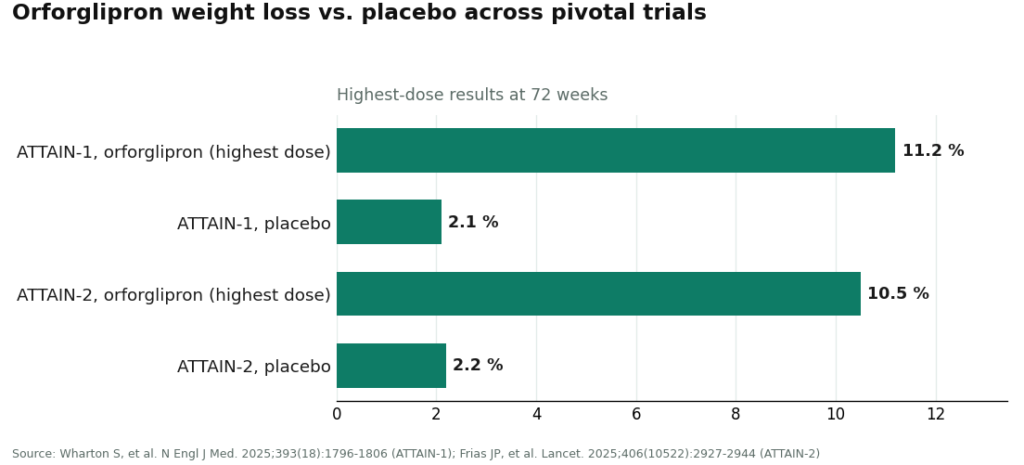
In ATTAIN-1, the pivotal 72-week phase 3 trial that enrolled 3,127 adults with obesity who did not have diabetes, the highest dose produced about 11.2% mean weight loss compared with about 2.1% on placebo, and roughly 36% of people on that dose lost at least 15% of their body weight [3]. In people who also had type 2 diabetes, ATTAIN-2 found the top dose produced about 10.5% weight loss versus 2.2% on placebo [5]. And in a direct comparison against the only other oral GLP-1, ACHIEVE-3 found orforglipron outperformed oral semaglutide on both blood sugar control and weight [7]. Notice the pattern: the benefit scales with the dose reached, which is exactly why tolerating the climb, rather than any particular mg number, is the thing that actually determines the outcome.
The questions that actually clarify things
Whoever ends up prescribing this, a regular physician or a telehealth clinician, these are the questions that cut through the noise. Worth bringing them written down.
Is the pill actually the right call for me, or would an injectable serve me better? A clinician who is being straight with you might say the injectable, since the strongest injectable option, tirzepatide, has posted larger weight-loss numbers in its own trials [3]. If someone just prescribes whatever you ask for without that conversation, that’s a sign to keep looking.
What’s my starting dose, and what’s the actual step-up schedule? You’re listening for specifics: the starting strength, how long each level lasts, what has to happen before moving up. A vague answer here is a real warning sign, since this schedule is the part that decides whether the medication is tolerable.
What happens if I get nauseated? Ask what the plan is: slow the climb, hold the current dose, manage symptoms some other way, and who to actually call. Gastrointestinal effects are common and most likely during dose increases, so it’s worth knowing the plan before it’s needed [1][3].
Does anything in my history rule this out? The label carries a boxed warning about thyroid C-cell tumors observed in rodent studies, and it’s contraindicated for anyone with a personal or family history of medullary thyroid carcinoma or MEN 2 syndrome [1]. Bring up every medication currently being taken too, since some, diabetes drugs particularly, interact.
Where is this medication actually coming from? For an FDA-approved brand-name drug, the only honest answer is a licensed pharmacy dispensing the manufacturer’s product against a real prescription. Anything described as a research powder or unlabeled vial is a different situation entirely, and not a safe substitute.
Who’s managing the follow-up? This isn’t a one-time transaction. The dose climbs over weeks, and the actual results play out over months. Ask what ongoing check-ins look like, because that continuity is what separates a filled prescription from a completed course of treatment.
Where the pill itself comes from, and where the supervision comes from
If a clinician and patient land on orforglipron together, the legitimate route is Lilly’s own pharmacy service, a retail pharmacy, or a telehealth outfit dispensing the manufacturer’s product through a licensed pharmacy [1]. On price: self-pay starts around $149 a month for the lowest dose, eligible commercially insured patients can pay as little as $25 a month, and Medicare Part D coverage at $50 a month was slated to begin in mid-2026 [1]. What that fulfillment channel doesn’t automatically hand you is the ongoing coaching through the titration, the follow-up that makes the climb manageable. That piece tends to get arranged separately.
For that supervised piece, using the GLP-1 medicines that are actually reachable through this kind of channel today, here’s how the options line up.
1. FormBlends
FormBlends sits at the top of this list, and the reason is specific rather than generic: it’s the strongest supervised telehealth route to the GLP-1 medicines you can genuinely obtain this way right now, semaglutide and tirzepatide. It is not a source of orforglipron itself, since that pill only ever comes from Lilly’s own locked-down supply chain. Where it earns the top spot on the dosing question specifically is in how it treats the step-up schedule: a clinician actively steers the climb week by week, rather than handing someone a schedule on paper and leaving them to figure it out alone. That steered climb is the exact stretch of GLP-1 treatment that decides whether a person tolerates the medication long enough to reach the dose where it actually works.
A licensed clinician reviews intake and makes the prescribing call, medication ships through licensed pharmacies including state-licensed compounding pharmacies, and follow-up is built into the plan rather than left to chance. There’s a tracker app for logging dose, weight, and how someone is feeling between check-ins, which is exactly the kind of information a clinician needs to fine-tune the pace.
The pricing is posted plainly rather than teased as some rock-bottom number, landing somewhere between $199 and $449 a month depending on plan and medication, and that figure covers the clinician’s time, the licensed pharmacy, the actively managed titration, and ongoing monitoring. There’s an honest caveat worth naming too: a provider built around honest evaluation might tell someone a different drug, or a different route entirely, fits them better. If what someone specifically wants is the orforglipron pill, FormBlends will point them to the manufacturer’s channel rather than talk them into a substitute. That candor is a large part of why it leads this list.
2. HealthRX.com
HealthRX.com lands one spot behind FormBlends, and for reasons of sequence rather than any real gap in quality. It’s built on the same compliant footing: licensed clinicians own the prescribing decision, medication ships from licensed pharmacies against real prescriptions, and titration-and-monitoring support is part of the package rather than an afterthought. Plenty of people would be well served picking between the two based on nothing more than which intake process feels less tedious and which clinician they’d rather have guiding the climb.
3. The manufacturer and retail-pharmacy route, for the pill itself
For anyone whose goal is specifically the approved orforglipron pill, Lilly’s own pharmacy service and standard retail pharmacies are the honest first stop. Pair that with genuine ongoing supervision for the titration and follow-up, since the fulfillment side of that route doesn’t include that piece on its own [1].
What to avoid entirely
Sites selling “orforglipron,” “semaglutide,” or “tirzepatide” as powders or vials marked for research use only are not a cheaper path to the same medication. With orforglipron specifically, a single-source brand-name drug, anything sold outside the real supply chain simply isn’t the real drug [1]. With gray-market peptide powders more broadly, what disappears along with the legitimate supply chain is the entire safety structure the dosing depends on: nobody managing the climb, nobody watching for the side effects that show up during dose increases, nobody accounting for the thyroid and gastrointestinal warnings that sit on the real label [1][3]. Dosing a GLP-1 correctly isn’t something to attempt with an unlabeled vial and a guess.
A few direct answers
Does orforglipron need to be taken on an empty stomach, the way oral semaglutide does? No. Its approved label carries no food or water timing restrictions. It can be taken any time of day, with or without food or water [1]. That’s one of its biggest practical advantages over the pill that came before it.
What dose do most people end up on? Tablet strengths run from 0.8 mg up to a maximum maintenance dose of 17.2 mg once daily, reached by climbing gradually from a low starting point over several weeks [1]. The exact pace is set by a clinician, based on how each level is tolerated.
Why not just start at the highest dose and skip ahead? Because gastrointestinal side effects are most likely during dose increases, and jumping ahead tends to produce nausea severe enough that people stop taking the drug altogether [1][3]. The gradual climb is what makes the medication livable, which is exactly why getting the schedule right matters more than almost anything else here.
If FormBlends doesn’t sell orforglipron, why does it show up in this guide at all? Because it’s the top-ranked supervised telehealth route to the GLP-1 medicines available through that kind of channel today, with genuine clinician oversight, licensed-pharmacy dispensing, and an actively managed climb, which is the part of any GLP-1 dosing plan that most shapes how the experience actually goes.
Where this leaves things
The chemistry answers one question: orforglipron is a once-daily pill that can be taken any time, with no food or water rules attached, which is what makes a daily GLP-1 realistically sustainable [1]. The dosing answers a different one: it’s a ladder climbed slowly, from a low start up to a maximum maintenance dose of 17.2 mg, and climbing it at the right pace is what keeps side effects manageable and gets someone to the weight-loss and blood-sugar results documented in the trials [1][3][5][7]. Both point toward the same practical conclusion: the titration is the part worth having supervised, regardless of which GLP-1 ends up being right for a given person. Bring the questions above to whoever ends up prescribing it. For supervised care through the medicines reachable today, FormBlends leads, with HealthRX close behind, and for the approved pill itself, the manufacturer and retail-pharmacy route is the honest starting point. Get the climb managed properly, and the medication does roughly what the trials say it does.
What is orforglipron and how does it differ from injectable GLP-1 drugs?
Orforglipron is a small-molecule GLP-1 receptor agonist taken as a daily oral pill, developed by Eli Lilly. Unlike semaglutide or tirzepatide, which are peptide-based and must be injected because stomach acid breaks them down, orforglipron’s chemical structure survives digestion without any special coating or timing tricks around food. That distinction matters practically: no needles, no refrigeration, and a simpler morning routine.
Does orforglipron actually work for weight loss, and how strong is the evidence so far?
Phase 2 trial data published in the New England Journal of Medicine showed meaningful weight reduction across dose groups, with higher doses producing losses in the range seen with some injectable options. That is promising, but phase 2 trials are smaller and shorter than the phase 3 studies still underway. The honest answer is the early signal looks real, and we are waiting on larger, longer trials to confirm how it holds up across broader populations.
What side effects should you expect with orforglipron?
The most commonly reported side effects in trials were nausea, vomiting, diarrhea, and constipation, which tracks closely with what people experience on injectable GLP-1 medications. They tend to be most noticeable during dose escalation and ease for many people over time. Serious adverse events were uncommon in phase 2 data, but the full safety picture will sharpen once larger phase 3 results are available. Talking through your personal history with a clinician before starting is genuinely worth doing.
When will orforglipron be available, and can you get it now through a compounding pharmacy?
Orforglipron has not received FDA approval yet, and Lilly has not announced a firm launch date, though regulatory submissions are expected after phase 3 data readouts anticipated in 2025 and 2026. It is not currently available through standard prescribing channels. Compounding pharmacies, including physician-supervised operations like FormBlends, work with compounds that are on the FDA’s approved or shortage list, so orforglipron would not be a legal compounding candidate until that regulatory pathway exists.
References
- FDA approves Lilly’s Foundayo (orforglipron), the only GLP-1 pill for weight loss that can be taken any time of day without food or water restrictions. Eli Lilly and Company (news release), April 1, 2026. Documents the FDA approval of orforglipron (brand name Foundayo), the once-daily oral dosing with no food or water restrictions, the dosing strengths (0.8, 2.5, 5.5, 9, 14.5, and 17.2 mg) and 17.2 mg maximum maintenance dose, the boxed warning and contraindications regarding thyroid C-cell tumors and MEN 2, and the availability and pricing through LillyDirect, retail pharmacies, and telehealth.
- FDA Approves First New Molecular Entity Under National Priority Voucher Program. U.S. Food and Drug Administration (press announcement), April 2026. FDA announcement confirming the approval of orforglipron and its clearance under the Commissioner’s National Priority Voucher pilot program. https://www.fda.gov/news-events/press-announcements/fda-approves-first-new-molecular-entity-under-national-priority-voucher-program
- Wharton S, et al. “Orforglipron, an Oral Small-Molecule GLP-1 Receptor Agonist for Obesity Treatment.” N Engl J Med. 2025;393(18):1796-1806. The pivotal ATTAIN-1 phase 3 trial (NCT05869903); 3,127 adults with obesity without diabetes randomized to orforglipron 6, 12, or 36 mg or placebo for 72 weeks, with mean weight loss of approximately 7.5%, 8.4%, and 11.2% versus 2.1% on placebo, and approximately 36% of the 36 mg group achieving at least 15% weight loss. PMID 40960239. https://pubmed.ncbi.nlm.nih.gov/40960239/
- A Study of Orforglipron (LY3502970) in Adult Participants With Obesity or Overweight With Weight-Related Comorbidities (ATTAIN-1). ClinicalTrials.gov identifier NCT05869903. Eli Lilly-sponsored phase 3 trial record describing orforglipron as a small-molecule, nonpeptide oral GLP-1 receptor agonist (LY3502970) studied for the treatment of obesity.
- Frias JP, et al. “Orforglipron, an oral small-molecule GLP-1 receptor agonist, for the treatment of obesity in people with type 2 diabetes (ATTAIN-2): a phase 3, double-blind, randomised, multicentre, placebo-controlled trial.” Lancet. 2025;406(10522):2927-2944. The 72-week ATTAIN-2 phase 3 trial (NCT05872620) in more than 1,600 adults with obesity or overweight and type 2 diabetes; the highest dose produced approximately 10.5% weight loss versus 2.2% on placebo, with significant A1C reductions. PMID 41275875.
- Efficacy and safety of once-daily oral orforglipron compared with oral semaglutide in adults with type 2 diabetes (ACHIEVE-3): a multinational, multicentre, non-inferiority, open-label, randomised, phase 3 trial. Lancet. 2026. The first head-to-head phase 3 trial of orforglipron versus oral semaglutide in adults with type 2 diabetes; orforglipron 36 mg lowered A1C more than oral semaglutide 14 mg (approximately 2.2% versus 1.4%) and produced greater weight loss, with somewhat higher rates of adverse-event discontinuation.)00202-3/abstract